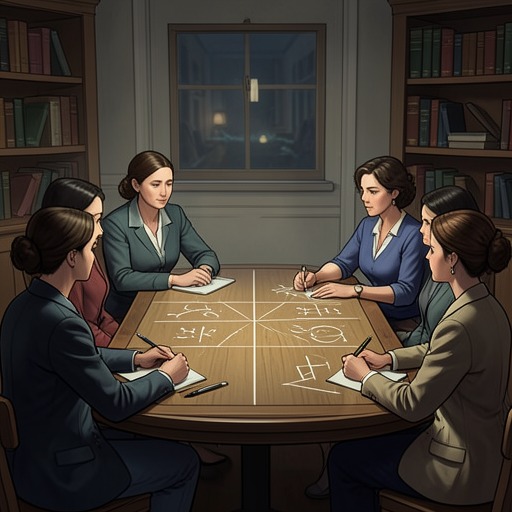
Molotschna Women's Three-Option Ballot
Women TalkingThe Molotschna Women’s Three-Option Ballot turned a crisis imposed on the women of Molotschna Colony into a choice they would debate and act upon together. The ballot offered Do Nothing, Stay and Fight, or Leave; the vote deadlocked between the latter two. With time short and the men’s return expected, the result did not settle the women’s course so much as establish the questions they would have to answer: whether safety required resistance or departure, and how either choice could be put into practice.
A choice under pressure
The vote took place as the remaining men of the colony, apart from those too frail or infirm to go, travelled to the city to post bail for imprisoned attackers. They hoped the men could return to Molotschna while awaiting trial. Peters had made belonging conditional: if the women did not forgive the accused men, he said, they would have to leave for an outside world they knew little about. The women had only two days to organize their response. In that setting, the ballot was not an ordinary expression of preference. It addressed a looming demand that the women absorb the consequences of the men’s return or face expulsion from their home.
The three options made different kinds of response legible. Do Nothing meant declining to alter the situation; Stay and Fight meant remaining in Molotschna while resisting what was being demanded; Leave meant giving up residence in the colony. The women’s collective rejection of Do Nothing narrowed the active debate to the two choices that required a change in their lives. The ballot thus established a common framework for discussion without pretending that the alternatives carried equal costs or that the women already agreed on the best one.
A deadlock that opened debate
As Ona Friesen later reported, the vote had ended in a deadlock between options two and three. The division followed, broadly, a family split: the Friesen women predominantly favoured staying and fighting, while the Loewen women preferred leaving. The positions were not fixed camps, however; convictions shifted on both sides. The absence of a decisive majority mattered because it prevented one family’s preference from being treated as the colony’s settled answer.
Instead, the women agreed that the two families would debate the advantages and disadvantages of the active options, decide which course was suitable, and then determine how to carry it out. That arrangement made deliberation part of the response to the crisis. The ballot identified the disagreement; the ensuing meetings gave the women a way to examine it collectively rather than leave the decision to the men returning from the city. It also tied principle to implementation: choosing whether to stay or leave would not be enough unless the women could organize the practical steps that choice required.
Neitje Friesen, sixteen-year-old daughter of the late Mina Friesen and now the permanent ward of her aunt Salome Friesen, created illustrations associated with the account. Her place in the family and her age give the record a generational dimension, although the evidence does not specify what the illustrations depict. The ballot and its accompanying record preserve a decision-making process in which the women’s own debate, not an outside authority’s verdict, becomes central.
From argument to a plan to leave
The deadlock did not end with a compromise to remain. As discussion continued, Ona Friesen proposed a heading for the written case for staying and fighting, showing that the competing position was given organized consideration. Later, when the case for leaving was being weighed, Salome Friesen asserted that there were no disadvantages to that option. The contrast between a structured debate over staying and this emphatic assessment of leaving marks a movement in the proceedings, though it does not by itself establish how every woman’s views changed.
The debate took place alongside the work of sustaining daily life. Salome Friesen suggested that Mejal Loewen fetch soup from the summer kitchen while she brought spelt bread she had baked that morning, so the women could eat lunch and continue meeting; instant coffee was also planned. As the day ended, singing stopped, the cows needed milking, and dogs belonging to a man away in the city still needed feeding. Agata Friesen addressed the women’s concern about such responsibilities by saying that the women on the ground could manage milking and supper preparations, while those in the hayloft stayed to resolve the remaining questions. These details make visible the labor surrounding the vote: the meeting depended on food, animal care, and the distribution of work, rather than taking place apart from them.
The decision eventually moved toward departure. At a later gathering, Agata Friesen asked whether it was agreed that the women would leave that night, after dark, to avoid being seen when passing the Chortiza and Hiakjeke colonies. The departure plan gave the ballot’s third option a route, a timing, and a shared purpose. The women’s decision was not simply an abstract preference for elsewhere; it involved moving together through a landscape where their passage might be observed.
Resources, risks, and significance
Preparation also required material resources. August Epp reported obtaining the co-op safe, a stick of dynamite, and a world map after the previous meeting. He later described wrapping the map around a large block of cheese and covering it with brown paper, placing the safe beneath the back seat of Greta Loewen’s buggy, and packing onions, soap, and pieces of wood to provide traction in mud or kindling for a fire. These supplies connect the collective decision to the demands of travel and subsistence: a map for orientation, food and household necessities, transport, and materials with more than one practical use.
The planned departure remained vulnerable to interference. Agata Friesen warned that the Koop brothers might wait for the women to move and then ride to the city to inform the men, or try to prevent the departure themselves. She also described their claim of a fire north of Molotschna as a way to push the women south, toward the city where the men were, and into a trap. The warning shows why the women’s choice of a night departure and a route past neighbouring colonies mattered: deciding to leave did not remove the danger of being followed or misdirected.
The ballot’s decisive significance lies in the gap between its simple list of three options and the difficult collective work that followed. A tie between resistance and departure exposed real differences among the women, while their agreement to debate and plan gave those differences a shared political form. The process ultimately led toward leaving after dark, with provisions and precautions assembled against uncertainty. The vote therefore records both a division of opinion and the emergence of coordinated action under the threat of forced forgiveness and expulsion.